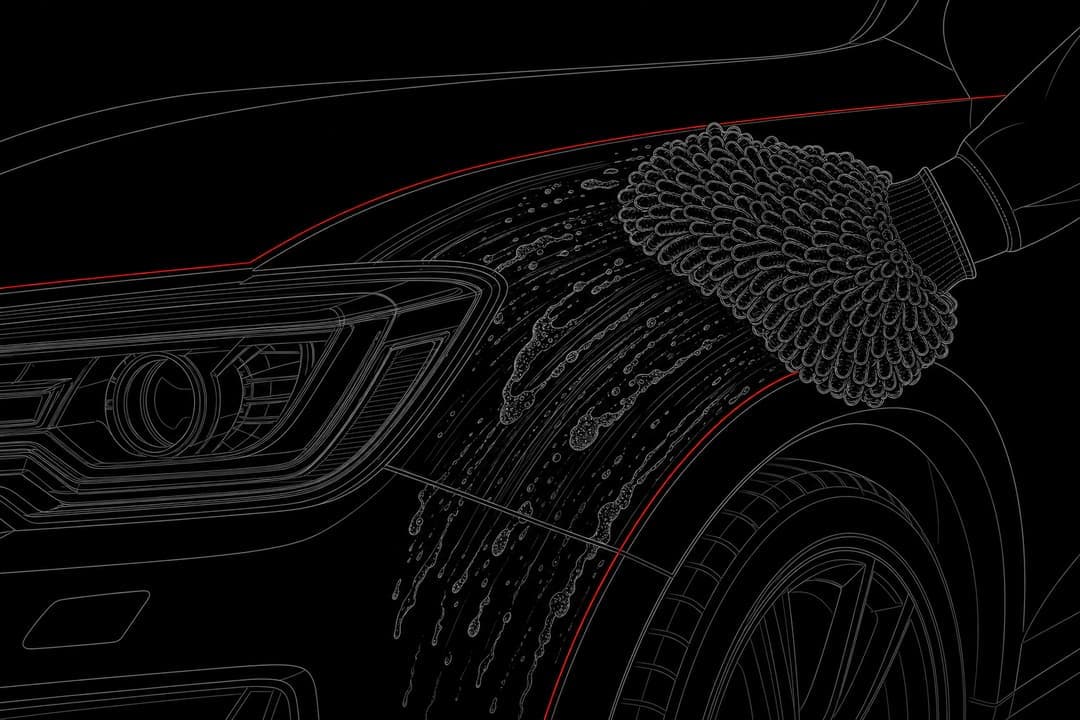
The short answer. Wash paint protection film by hand with a pH-neutral shampoo and the two-bucket method. Keep it out of brush and soft-cloth tunnel washes. Get love bugs, bird droppings, and sap off within a day. Seal the film with XPEL Ceramic Boost at least every six months, and keep a pressure washer away from the film's edges. Do those five things and XPEL film on a Boca Raton daily driver stays clear and glossy for the length of its warranty.
Most film that looks tired at year three was let down by the wash routine, not the film. Below is the routine we give customers at our Dixie Highway shop, built on XPEL's own care instructions plus the South Florida problems a generic care card skips.
What paint protection film actually is (fast recap)
Paint protection film is a clear layer of thermoplastic polyurethane (TPU) bonded to your paint with an adhesive. XPEL Ultimate Plus is 8 mil thick, which is about twice the thickness of a business card. On top of the urethane sits a thin topcoat. That topcoat is what gives the film its gloss, its stain resistance, and its ability to self-heal light scratches.
For maintenance purposes, the topcoat is the part that matters. The urethane underneath is tough and stays protected as long as the top layer is healthy. Almost everything in this guide is about not damaging that topcoat with the wrong chemical, the wrong towel, or the wrong car wash.
Three XPEL films cover most of what we install on paint protection film in Boca Raton:
The care routine is nearly identical for all three. Where Stealth or Ultimate Fusion differ, we call it out.
- XPEL Ultimate Plus, the high-gloss clear film (listed on our site as Ultimate Premium).
- XPEL Stealth, the satin finish film.
- XPEL Ultimate Fusion, a gloss film with a hydrophobic topcoat built in, so water beads off the film without a separate coating.
The two rules that matter most in Florida
Rule 1: nothing harsh, nothing abrasive
XPEL's warranty excludes damage from harsh cleansers and solvents, and from improper wash techniques or wash tools that cause abrasion. In practice that means no dish soap, no strong degreasers, no rubbing compounds, and no gritty sponges. A pH-neutral car shampoo is the default for every wash.
Rule 2: get contamination off within 24 hours
XPEL's care sheet says to remove insects and other stains as soon as possible. In Boca that is not a suggestion. A car parked in an open lot in August gets hot enough to bake bug residue, bird droppings, and sap into the topcoat. UF/IFAS notes that love bug residue left on a car for several days turns more acidic as it breaks down. Film buys you time. It does not buy you a week.
Your basic weekly wash routine
Every week or two is the right cadence for a car parked outside in Palm Beach County. A garaged weekend car can stretch a little longer. Wash sooner after a beach run, a love bug drive, or a heavy pollen day.
The two-bucket method, adapted for a Boca driveway
One bucket holds soapy water. The other holds plain rinse water for the mitt. Dip in soap, wash one panel, rinse the mitt in the clean bucket, then go back for more soap. Grit stays in the rinse bucket instead of going back onto the car. If your HOA limits hose use, a rinseless wash with plenty of towels works on a lightly dirty car. It is not enough for dried love bugs or storm grime.
pH-safe soap
XPEL sells its own Wash Solution and Foam Soap, and those are the safest pick for film. Other pH-neutral shampoos such as Gyeon Bathe and CarPro Reset are widely used on film-wrapped cars. Skip anything sold as a "wash and wax." Wax with dyes or solvents does not belong on the film.
Order of operations
- Work in the shade on a cool car. Early morning or evening. A hot panel dries soap into spots before you can rinse.
- Rinse from the top down. Knock off loose sand and pollen before anything touches the film.
- Foam or pre-soak. Optional, but it loosens grime and bugs before contact.
- Contact wash with two buckets. Roof first, lower panels last, straight-line passes with light pressure. Use a separate mitt for the rockers, where the grit lives.
- Rinse thoroughly. Soap left to dry leaves its own residue.
- Dry completely. Plush microfiber or a blower. Never let water air-dry on the car.
What to do about love bugs, bird droppings, and tree sap
The 24-hour clock
Fresh residue is easy. Soak it with warm water or a wet microfiber for a minute, then lift it off with a soft wipe. The longer it sits in the sun, the more it bonds to the topcoat and the more likely it is to leave a stain. Florida gets two big love bug flights a year, in spring and again in late summer. During those weeks, a quick rinse of the front clip after every highway drive is the cheapest insurance you can buy. Our love bug season guide goes deeper on this.
Safe bug and stain removers
XPEL recommends its Film Cleaner for insect and other stains. For residue that will not lift, XPEL's care sheet allows 99 percent isopropyl alcohol on the film. Apply it to a microfiber, not the car, work a small area, and keep it off any unfilmed paint.
What not to use
Kerosene, WD-40, or other petroleum solvents. Bug and tar removers not labeled safe for film. Dryer sheets, scrub pads, or your fingernail on dried bug shells. Soak first, then wipe.
Drying without swirls
Microfiber, not cotton
Use a plush or twisted-loop microfiber drying towel and drag it gently. Cotton bath towels and real chamois are too grabby and leave fine marks in the topcoat.
Blowers for the edges
A leaf blower with a clean nozzle, or a dedicated car dryer, pushes water out of mirrors, badges, and panel gaps. Keep the airflow moving along the film edge, not aimed straight into it, so you are not lifting the edge.
Automated car washes and PPF: what is safe, what is not
Touchless: the least-bad option
A touchless wash uses chemicals and water pressure instead of brushes. Nothing physical drags across the film, which is the main point. The catches are the strong presoak chemicals some bays use and high-pressure jets hitting film edges. Use touchless when you have to, not every week.
Soft-cloth tunnels
The cloth strips carry grit from every car before yours. Repeated trips dull the topcoat over time.
Brush tunnel washes: never
XPEL's warranty specifically excludes damage caused by automatic car washes and incorrect wash tools that cause abrasion. A brush tunnel can also catch a film edge and lift it. If the car has film, these are off the list.
Florida-specific stuff that shortens topcoat life
A1A salt aerosol
Drive A1A through Highland Beach or park near the beach in Deerfield and the car picks up a salty film you can feel. Rinse the front clip and rocker panels with plain water the same day. Salt left on edges dries into crust that can work its way under them.
I-95 truck spray and Turnpike construction fallout
Construction zones on I-95 and the Turnpike leave gritty road film on the lower half of the car. Pre-rinse thoroughly before any mitt touches those panels.
Afternoon thunderstorm mineral spotting
June through September, the 3 p.m. storm rolls through, the sun comes back out, and mineral-heavy water bakes onto the car. XPEL's warranty does not cover water spots. Sprinkler overspray does the same thing. If you can, rinse and dry the car before storm spots have a chance to set.
Pollen season in March and April
Spring pollen leaves a chalky yellow film that makes the topcoat look dull. A normal wash removes it. Never wipe it off dry with a towel. That is how you scratch the topcoat.
Heat accelerates staining
Summer UV in South Florida regularly sits in the EPA's very high to extreme range. Contamination left on a sun-baked panel stains faster than the same mess on a cool car. Covered or garage parking during the hottest months is the single easiest upgrade for film life.
Quarterly and annual maintenance
Seal it with Ceramic Boost
XPEL's care sheet for Ultimate Plus, Ultimate Fusion, and Stealth says to seal the film with XPEL Ceramic Boost at least once every six months. On a car that lives outside in Boca, every three months is a sensible rhythm. Spray it onto a clean, dry panel and buff with a fresh microfiber. On Stealth, it keeps the satin finish even instead of blotchy.
Decontamination and reset
XPEL's care sheet says detailing clay can be used to remove contaminants from the film. Use a fine-grade clay or clay mitt with plenty of lubricant and light pressure. For iron fallout and rail dust, use only products labeled safe for PPF. Once a year, ideally after the fall love bug flight and hurricane season wind down, let the shop do a full decontamination and inspection. Our ceramic and PPF maintenance detail covers it.
Ultimate Fusion owners: book the annual inspection
XPEL's warranty terms for Ultimate Fusion require an annual inspection by an XPEL-certified installer, within 30 days of the installation anniversary. Miss the window and the warranty can be voided. Put it on the calendar the day you pick up the car.
Self-healing: what actually reflows and what does not
How the topcoat reflows
The topcoat is an elastomeric polymer. Heat lets it relax back into shape and fill in light scratches. XPEL says light scratches self-heal in 20 to 30 minutes at room temperature. In colder conditions, or to speed it up, XPEL recommends pouring warm water around 120°F over the area. In Boca, parking in the sun for an afternoon usually does the job.
What heals and what does not
Fine wash marring, fingernail marks around door handles, and light swirls heal. A rock chip that punches through the film or a key scratch will not. The film did its job by taking the hit instead of the paint, and the fix is replacing that panel's film.
Go easy with a heat gun
Warm water and sunshine are all most scratches need. If you use a heat gun, keep it on low, keep it moving, and keep it well away from the surface. Too much heat in one spot can damage both the film and the paint under it.
Products we recommend, and the ones we do not
- Soap: XPEL Wash Solution or Foam Soap. Gyeon Bathe and CarPro Reset are good pH-neutral alternatives.
- Spot cleaning: XPEL Film Cleaner, and 99 percent isopropyl alcohol on a towel for stubborn stains.
- Sealant: XPEL Ceramic Boost, at least every six months.
- Towels: plush microfiber for drying, separate mitts for upper and lower panels.
- Skip: any polish or compound with abrasives, any wax containing dyes or solvents, and any ceramic coating that is not XPEL-branded. XPEL's film warranty excludes problems caused by non-XPEL ceramic coatings.
What can void an XPEL film warranty
XPEL's ten-year film warranty covers defects like yellowing, cracking, blistering, and delaminating on professionally installed film. It is conditioned on following XPEL's care instructions. The exclusions that trip up owners most often:
Rock and road debris impacts are also excluded. The film is a sacrificial layer, and taking those hits is its job.
- Automatic car washes and wash tools that cause abrasion.
- Harsh cleansers and solvents, along with excessive heat.
- Water spots from mineral deposits left to dry on the film.
- Non-XPEL ceramic coatings applied over the film.
- Missed annual inspections on Ultimate Fusion.
When to call the shop instead of DIY
Want a professional set of eyes on your film? Get your quote for a maintenance visit, or call the shop at (561) 367-0101.
- Edge lifting on a bumper corner, rocker, or door edge. Caught early, it can often be fixed before dirt gets under it.
- Yellowing, hazing, or bubbling that does not wash off. That is a warranty inspection, not a polishing job.
- A deep scratch or a chip through the film. We can tell you whether the panel needs new film or just a spot repair.
- Dull film that a wash and Ceramic Boost will not bring back. Usually it is contamination, and a professional decontamination brings it back.
Our take
Our take: for a Boca daily driver, the whole game is a hand wash every week or two, Ceramic Boost every few months, and one professional decontamination a year. Skip the tunnel wash, buy a bottle of pH-neutral soap, and honor the 24-hour rule on love bugs. Do that, and XPEL film looks close to install day for the full length of its warranty. If you want to know what "full length" really means in this climate, our guide to how long PPF lasts in Florida breaks it down.
Frequently asked questions
Can I take my PPF-wrapped car through a touchless car wash?
Occasionally, yes. Touchless is the least-bad automatic option because nothing physically drags across the film. Watch for strong presoak chemicals and high-pressure jets aimed at film edges. Hand washing is still better for regular care.
How soon after install can I wash the car?
XPEL's care instructions say to wait 48 hours after installation before washing. Follow the aftercare card you get at pickup, since your installer may give you a specific window for your car.
Can I ceramic coat over XPEL PPF myself?
We do not recommend it. XPEL's film warranty excludes problems caused by non-XPEL ceramic coatings, and XPEL Fusion Plus is a professional-install product. XPEL Ceramic Boost is the owner-applied topper XPEL recommends for film.
Will pressure washing damage my film?
It can if the jet hits the film's edges. XPEL warns against using a pressure washer near film edges because it can lift the film. Keep the nozzle well back, use a wide fan tip, and aim across the panel, not into an edge.
What if a love bug sits on the hood for a week?
Soak it with warm water or XPEL Film Cleaner and lift it off gently. If a mark remains, try 99 percent isopropyl alcohol on a microfiber. If a stain still shows, let us take a look. A week of Florida sun can leave a mark even on film.
Do I need to seal the edges?
No. Edges are finished at install, and we wrap edges wherever the panel allows. Your job is to keep pressure washers, brushes, and towels from catching them.
Can I use a clay bar on PPF?
Yes. XPEL's care sheet says detailing clay can be used to remove contaminants from the film. Use plenty of lubricant and light pressure.
How often should I reapply a ceramic topper?
XPEL says to seal the film with Ceramic Boost at least once every six months. On a car parked outside in Boca, every three months keeps the gloss and beading strong.
Will the self-healed scratches come back?
No. Once the topcoat reflows, the scratch is gone. A new scratch in the same spot heals the same way.
Is it safe to polish the film if it looks dull?
Not with cutting compounds or abrasive polishes. Dullness is usually contamination or a worn sealant layer. Wash, decontaminate, and apply Ceramic Boost first. If it is still dull, book an inspection.
Book a maintenance reset at Auto SuperShield
We are an XPEL-certified paint protection film, ceramic coating, and window tint shop serving Boca Raton, Delray Beach, Deerfield Beach, Highland Beach, and Palm Beach County. If your film needs a decontamination, a Ceramic Boost top-up, an Ultimate Fusion annual inspection, or a look at a lifted edge, get your quote or call the shop at (561) 367-0101. Coated cars have their own routine too. See our ceramic coating maintenance guide.
Auto SuperShield, 4701 N Dixie Hwy, Boca Raton, FL 33431. Phone: (561) 367-0101.