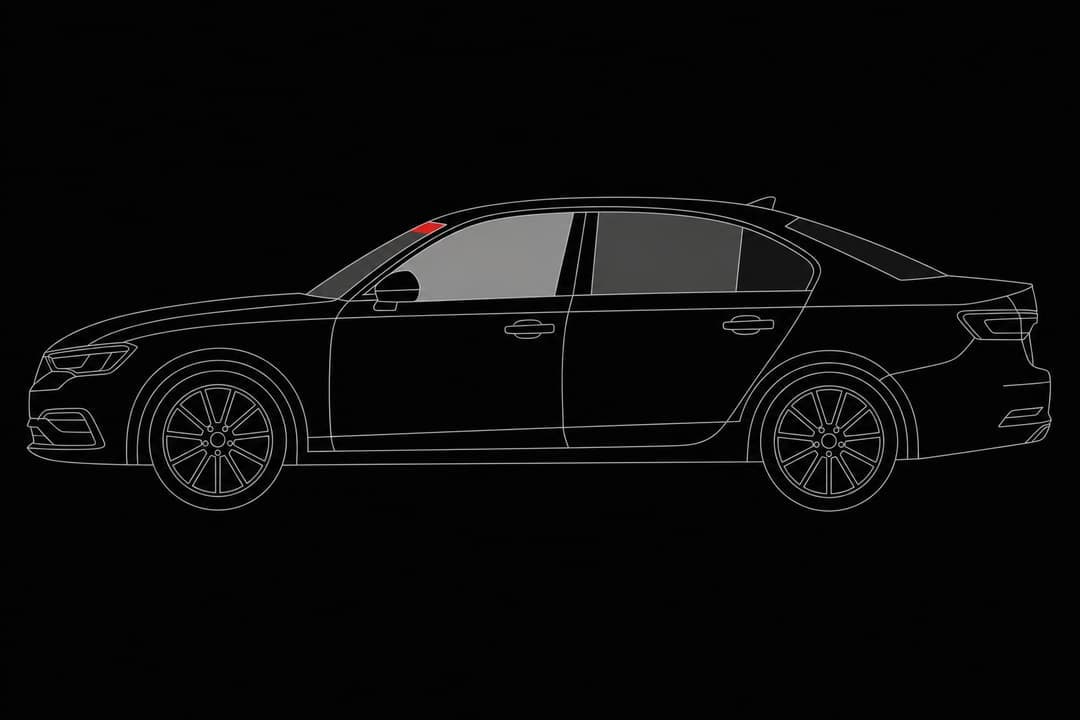
Florida tint law comes down to one number per window: VLT, or visible light transmission — the percentage of light that gets through. Lower number, darker tint.
The part almost every guide skips: the law measures the film after it is on your car, not the film on the roll. The statute says the material is tested when applied to and tested on the glass of that specific vehicle. Your factory glass already blocks light before any film goes on, so a 35% film on 80% factory glass does not come out at 35%. That is why a roll rated at the legal limit can still fail a meter.
Here is what the statute actually says, window by window, and where people get caught.
The short version
- Front side windows, every vehicle: at least 28% VLT, no more than 25% reflectance
- Behind the driver, cars: at least 15% VLT, no more than 35% reflectance
- Behind the driver, multipurpose vehicles: at least 6% VLT, no more than 35% reflectance
- Windshield: a transparent strip above the AS-1 line only — nothing below it
- Tinted rear window: working side mirrors required on both sides
Front side windows — the same rule for every vehicle
The windows next to the driver and front passenger must let through at least 28% of visible light and reflect no more than 25%. There is no SUV exception here. A lifted truck and a sedan get the identical number up front, which surprises people who assume the whole vehicle follows the truck rule.
This is also the window that gets checked at a traffic stop, because it is the one the officer is looking through.
Behind the driver — and the SUV rule most guides get wrong
Every window behind the driver on a car must let through at least 15% of visible light. On a multipurpose passenger vehicle the floor drops to 6%, effectively limo dark. Reflectance is capped at 35% either way.
Here is the part that matters: "SUV" is not the legal test. Florida defines a multipurpose passenger vehicle as one designed to carry ten people or fewer that is built either on a truck chassis or with special features for occasional off-road use. Plenty of modern crossovers are unibody family cars wearing SUV bodywork, with no truck chassis and no off-road hardware. Body shape is not the standard. Construction is.
If you are not sure which side of that line your vehicle falls on, ask before the film goes on rather than after. We check the vehicle against that definition as part of the quote.
The windshield
No sunscreening material anywhere on the windshield except a strip along the top, and that strip must be transparent and must not reach into the driver's forward view — the area federal standard FMVSS 205 calls the AS-1 portion. Most windshields have the AS-1 line marked in the glass near the top edge. That mark is your boundary.
Note the word the statute uses: transparent. It sets no VLT percentage for that strip, and it does not authorise a dark brow. Florida separately allows a few non-tint items on the windshield — a certificate or permit required by law, an electronic toll transponder, and a GPS or satellite navigation device.
Full-windshield protection film is a different animal. Optically clear windshield film is not sunscreening material and does not reduce light transmission the way a tint does, which is how it stays inside the rules.
Reflectivity — where mirror and chrome films fail
VLT is only half the test. Florida caps reflectance at 25% on the front sides and 35% behind the driver, measured on the outside of the glass. A film can sit comfortably above the VLT floor and still be illegal because it throws back too much light.
That is what rules out the mirrored and heavily metallic films people ask us for. If it looks like a mirror from outside the car, assume it fails.
Perforated, louvered, and covered windows
Behind the driver, Florida also permits a few things that are not conventional film:
- Perforated sunscreening: at least 30% light transmittance and no more than 35% reflectance, with no single measured section exceeding 50% reflectance
- Louvered materials: allowed as long as they do not cut driver visibility by more than half
- Privacy drapes, curtains, and blinds: allowed, but they must be open and secured while the vehicle is being driven
The mirror requirement people forget
If your rear window is treated to the point that it is no longer transparent, Florida requires working side mirrors on both sides of the vehicle. Tint the back glass dark and lose a mirror, and you have created a second violation on top of the first.
Medical exemptions
Florida issues medical exemption certificates to people affected by lupus, any autoimmune disease, or other conditions requiring limited exposure to light. The certificate permits sunscreening on the windshield, side windows, and windows behind the driver that would otherwise break the limits.
Two practical details catch people out. The certificate is tied to one specific vehicle — it records the make, model, year, VIN, decal number, and registered owners. And it is nontransferable: it becomes void the moment that vehicle is sold or transferred, so it does not follow you to your next car.
The state may charge a fee to issue one. If you hold a certificate, bring it to your appointment and we will build the car around what it permits.
Florida separately exempts law enforcement vehicles used in undercover or canine work, and vehicles owned or leased by certified process servers and licensed private investigators.
What it costs if you get it wrong
For the driver, operating a vehicle with illegal sunscreening is a noncriminal traffic infraction, handled as a nonmoving violation. Replacing or repairing material that was legally installed is not a violation.
For the shop, it is considerably more serious. Under Florida law, selling or installing sunscreening material that violates these sections is a second-degree misdemeanor. That is the real reason a reputable installer will decline to put 5% on your front doors — not squeamishness about a ticket you might absorb, but a criminal charge against the business that installed it.
If a shop offers to do it anyway, you have learned something useful about that shop.
Legal and still cool — the part that actually matters here
Dark is not the same as cool. Heat rejection comes from what the film is made of, not from how dark it looks. XPEL Prime XR Plus is nano-ceramic: it blocks the infrared that makes a cabin unbearable and over 99% of UV at any shade, including shades light enough to be legal on every window of the car.
That is where most of our customers land — the legal limit for the look, with the ceramic layer doing the temperature work. A car that is comfortable in August without a fix-it ticket in the glovebox.
Every install we do in Boca Raton is checked against the current statute for that specific vehicle before film touches glass.
Sources
This is a plain-English summary, not legal advice — the statute governs, and it can be amended. The rules above come from Florida Statutes 316.2951 (definitions), 316.2952 (windshields), 316.2953 (side windows), 316.2954 (windows behind the driver), 316.29545 (medical and agency exemptions), and 316.2956 (penalties). Every figure was verified against the statute text on 30 July 2026.