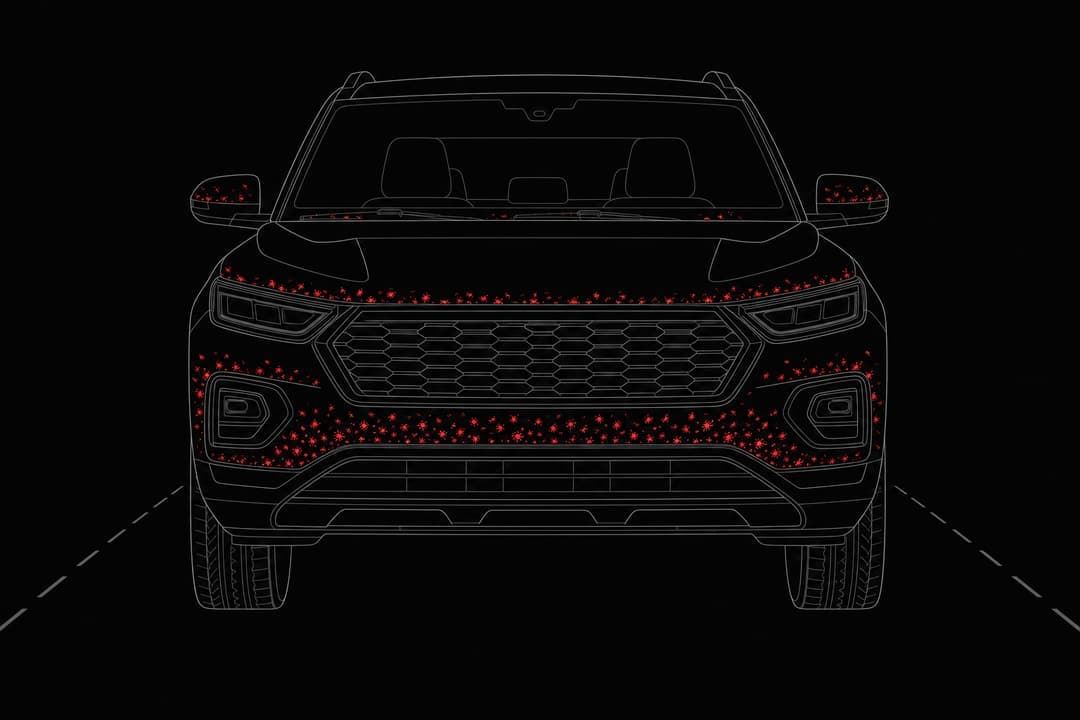
The short answer. Wash love bugs off within a day. University of Florida entomologists recommend exactly that, because the residue gets more acidic the longer it sits and, left for several days, can etch into your paint. The long-term fix for a daily driver in Boca Raton is paint protection film on the front end and ceramic coating on the rest, so the residue lands on a sacrificial layer instead of your clear coat.
Why late summer and spring are love bug months in Boca Raton
The love bug, Plecia nearctica, is a small fly with a black body and a red thorax, usually seen flying in joined pairs. UF/IFAS Extension describes two big flights each year, one in April and May and one in August and September, each lasting about four weeks. They have been collected in Florida in every month except November, but those two windows are when the front of your car collects them by the hundreds.
Why they swarm the highway
According to UF/IFAS, love bugs are drawn to vehicle exhaust fumes, and engine heat and vibration likely add to the attraction. That is why the worst of it happens on the roads with the most traffic. Around Boca that means I-95, Florida's Turnpike, and US-1 through Delray and Deerfield. A single Turnpike run to Fort Lauderdale during a heavy flight can coat a bumper.
What love bug residue actually does to car paint
The damage is a slow process, not an instant one. UF/IFAS explains that the bugs' body fluids are only slightly acidic when they hit. The problem starts when the residue sits. Over several days, bacterial action increases the acidity, and that is what etches the paint. September heat speeds up how fast residue dries and bakes on.
That gives you a real window, and UF/IFAS extension entomologist Tom Fasulo's advice was to wash cars within one day. Past that, you are in the zone where etching becomes possible, especially on a dark car parked in the sun.
Etching is damage in the clear coat itself. Light etching can often be polished out. Deeper etching means removing more clear coat to level it, and clear coat is finite. On a car that has already been polished a few times, that can mean there is not enough left to fix it, which is where a repaint enters the conversation.
Love bugs cause other problems too. UF/IFAS notes they can reduce visibility through the windshield and even cause cars to overheat.
The love bug removal protocol
This is what we tell every customer to do after a swarm drive:
What not to do
- Do not dry-wipe dried bugs. You are dragging hard, crusty debris across the paint and will leave scratches.
- Do not reach for a stiff brush or scouring pad. Both scratch clear coat and film.
- Skip the household hacks. Dryer sheets and WD-40 get passed around every September. Neither is made for automotive finishes. Dryer sheets can be abrasive when rubbed dry, and petroleum residue has to be washed off anyway. A proper bug remover and a soak do the job without the risk.
- Do not park it in the sun and wait. Heat is what bakes residue into the finish.
The rinseless wash workaround
Plenty of Boca townhouses and HOAs restrict hose washing. A rinseless wash, where you clean panel by panel with a dilute solution and a stack of microfiber towels, works well for light, fresh bug residue and routine dust. Soak each area, wipe gently in one direction, and fold to a clean side of the towel often.
It is not the right tool for a front end caked in dried, baked-on bugs. There is too much hard debris to lift safely with towels alone. In that case, soak the area thoroughly first or take the car somewhere you can rinse it properly.
How paint protection film handles love bug acid
Paint protection film puts a clear urethane layer between the residue and your clear coat. XPEL describes Ultimate Plus as a very low surface energy film designed to resist staining. The residue sits on the film instead of the paint, and if anything is marked, it is the replaceable film, not the factory finish.
You should still wash the bugs off promptly. Film buys you margin, not permission to leave residue baking all week.
The areas that catch love bugs are the same ones that catch rock chips: the front bumper, the hood, the mirrors, the headlights, and the leading edge of the fenders. That is exactly what our full front package covers. Film choices that suit love bug country:
- XPEL Ultimate Plus (listed on our site as Ultimate Premium): high gloss, stain resistant, self-healing.
- XPEL Ultimate Fusion: the same film with a hydrophobic topcoat built in, so residue releases more easily at wash time.
- XPEL Stealth: a satin finish for matte paint, which cannot be polished if it etches.
How ceramic coating handles love bug acid
Ceramic coating gives the paint a chemical-resistant, slick layer. Love bugs stick less firmly and release faster at wash time, and the coating takes the first exposure instead of the clear coat. XPEL says its Fusion Plus coatings help protect surfaces from insect acids.
What ceramic does not do is make residue harmless. A coating is thin. Leave bugs on it for days and the acid can work through to the paint. Treat a coated car the same as any other during a swarm: wash within a day. A ceramic booster spray after each wash in September keeps the surface slick.
The Boca Raton love bug protection stack
Our take: for a car that commutes on I-95 or the Turnpike, the right setup is full front PPF plus ceramic coating on everything else. Film covers the areas that take the most bugs and the most chips. Coating makes the rest of the car easy to clean. It is the same setup that handles salt air, pollen, and summer storms, so it pays off the other ten months of the year too.
Beyond paint, check the front of the car after each swarm. Clear bugs out of the grille so air keeps reaching the radiator, and look at your wiper blades, which smear bug residue across the glass once they wear. UF/IFAS also suggests a hood deflector or screen to help protect the paint. Our windshield protection film adds a replaceable layer to the glass as well.
Your September love bug routine
Want the front end protected before the next flight? Get your quote, or call the shop at (561) 367-0101.
- Before a long highway drive: make sure the car is clean and a booster or coating is fresh, so residue has less to grip.
- After the drive: rinse the front end the same day, even if the full wash has to wait until the next morning.
- When the flight ends: do a full decontamination wash with iron remover and clay to clear anything left behind. Our auto detailing service can handle this in your driveway.
Frequently asked questions
When is love bug season in Florida?
UF/IFAS describes two major flights each year, in April and May and again in August and September, each lasting about four weeks. Smaller numbers turn up through most of the year.
How long can love bugs stay on my car before damaging paint?
UF/IFAS advice is to wash them off within a day. The residue becomes more acidic as it decomposes over several days, and that is when it can etch the paint. Heat and sun speed things up.
What is the fastest way to remove dried love bugs?
Soak first. A dedicated bug remover or a wet microfiber towel laid over the area for a few minutes softens the residue so it rinses and washes off without scrubbing.
Do dryer sheets or WD-40 really work on love bugs?
People use them, but neither is made for automotive paint. Dryer sheets can scratch when rubbed dry, and petroleum products leave residue that has to be washed off anyway. A proper bug remover is safer and just as fast.
Will PPF stop love bug damage completely?
It keeps the residue off your paint, and quality film like XPEL Ultimate Plus is built to resist staining. You should still wash bugs off promptly so the film stays clear.
Is ceramic coating enough for love bugs, or do I need PPF?
Ceramic makes bugs much easier to remove and adds a chemical-resistant layer, but it is thin. If you commute on I-95 or the Turnpike, film on the front end is the stronger protection. Coating works well for the rest of the car.
Can love bugs damage a fresh ceramic coating?
A new coating is still hardening in its early days, so do not let residue sit on it. Rinse bugs off gently and follow your installer's aftercare card for when a full wash is safe.
Does Auto SuperShield offer a love bug decontamination detail?
Yes. Our exterior detail includes a wash, decontamination, and machine polish, and our ceramic and PPF maintenance wash is safe for protected cars. We can come to your home or office.
How do I book a wash or PPF quote?
Call the shop at (561) 367-0101 or use our quick quote form.